
Even given the optimism exuded by our southern flank, the fact remained that sales remained difficult owing in no small part to the propaganda emanating from our principal Left Coast competitor. Today we would call this campaign one of spreading “misinformation”.
Cisco launched its IPO in February, 1990. The stock increased in value from the initial offering price by over 20% at the end of the first day of trading. Such a resounding financial performance would naturally pump up the spirits of every Cisco employee. Their hard work was being rewarded by the faith shown in them by institutional Wall Street investors. They had a right to feel good about their company.
That success also served to embolden a sizable percentage of their sales staff to ramp up the volume on some of their favorite negative marketing messages aimed squarely at us – “their products don’t support [fill in your favorite missing feature]”; “Wellfleet is obviously failing because they are raising more money”; “there is management turmoil over there”, etc, etc. Repeatedly, our field sales people were getting bombarded with these comments from our prospective customers. Our question was a simple one – where is this coming from? Some of our sales reps had an idea, but little evidence.
We had our suspicions confirmed by an encounter at a meeting at NYSERnet to discuss the state of what was to become the Internet standard protocol for network management – SNMP – as recalled by a participant:
Oh yes…..good ole F. Terry Eger….
I can’t remember exactly where that meeting was but it eventually lead to a “bake off” at RPI sponsored by the NYSERNET folks (Marty Schoffstall) as a interoperability showcase….. I was working for [redacted] at that point and was transitioning from engineering (where I was the design lead on SGMP) over to product management (where is was asking “why aren’t we calling is Simple Network Management Protocol and making a much broader standard.”)
Anyway, F. Terry showed up, late, and stated something to the effect: “Why should Cisco even lend its name to this, we will do whatever the customer asks us to do.” He left shortly adding “You all will be working for us someday.” It appears in my case (and Vah, Yates, and a few others) he was correct 😦
As typical of Cisco’s sales strategy they were promoting their own “standard” of things and was aggressively promoting something else at that time, I think it was HEMS (Host Entity Monitoring System). It was a prequel of the IGRP verses OSPF interior gateway standard marketing bullshit.
Anyway, that meeting is where I met Willis for the first time, and my comment to the group after Terry left was “well, I now know what the “F..” stands for….” That meeting resulted in a life long friendship and directly led to my coming to Wellfleet.
F. Terry Eger was one of the first seven employees of Cisco, and was the first to exclusively carry a sales bag. He was a highly energetic sales person, a fierce competitor, and tenacious beyond belief.
John Morgridge, Cisco’s first CEO, and Don Valentine, Cisco’s first investor, describe Eger in their oral history of Cisco in their interview with John Holler in December, 2014 for the Computer History Museum:
Valentine: See, Terry Eger, one of my favorite sales managers over the ages, was encountering being in a big company. And he was neither suited to run the sales force of a big company. We were doing $100 million. This was the world’s greatest face to face salesman. [my emphasis added -wms]
Morgridge: Great strategist.
Hollar: What made him so good?
Valentine: It didn’t matter to him where the customer was located. If the customer was on a canoe in the middle of Hudson Bay, he’d find a way to land a sea plane in the middle of Hudson Bay and talk to him.
Morgridge: He was tenacious. And he was very good with secretaries. So he knew a lot about his targets.
Valentine: Just the ideal, from my point of view for startups, you have to recognize, I’m dealing with a company that has five employees. So someone like Terry that I had recruited and hired before John arrived was one of the early people in a lot of the respects of the company, including my vague recollection of the fist fight. He was one of the two people in the fist fight.
Morgridge: He was a very strong personality, and this was a company of strong personalities, particularly one of the founders. The other founder, are occasionally. And some of the other people that we– or I–hired were also strong personalities.
So he could maintain his own under any set of circumstances, but he was basically a first rate salesman and sales strategist. I called him the router barbarian because you either bought from one or was scorched earth. I mean, he was tenacious.
Valentine: To me, the ideal of ingredient for a startup.
Morgridge: Absolutely correct.
So, that’s one point of view as seen by Cisco’s CEO and sole venture investor.
We had a slightly different perspective on Mr. Eger’s barbarous antics. Most of us had had our “basic training” in sales tactics from companies like Hewlett-Packard and Digital Equipment. One of the tenets of computer sales was to extol the virtues of your products and not waste the customer’s time on bashing your competitors’.
Clearly, that notion was not in the Cisco sales handbook. This was bare-knuckles competition. The rules of the Marquess of Queensberry did not apply in the fight between Cisco and Wellfleet. Still, it was difficult for some of us to be seen as lowering ourselves to the level of our principal competitor. We strived to win over our prospective customers by being calm, factual, and adopting a business-like demeanor in our interactions with them. It is possible to be persistent without being obnoxious. We decided to leave the histrionics to the other guys.
Of course, being on the defensive in any sales situation means being one step behind the competition. Our principal means of defense was to cite what we knew to be verifiable facts – “we are a growing company, additional private financing will allow us to continue to grow to achieve profitability”; “we do not nor will we ever support Banyan Vines”; “our performance is consistently high regardless of protocol type – Cisco’s products are not”, and so on.
The fact remained, however, that Cisco started up in 1984 – we didn’t recruit our first engineers until the fall of 1986. We were always two years behind. And although the Wellfleet hardware platform was visibly and architecturally superior to Cisco’s in the eyes of anyone who bothered to make an objective comparison, we were consistently behind Cisco in delivering an ever-increasing list of software features that customers expected.
The router market was growing rapidly in the late 80s, and continued to accelerate throughout the 1990s. Initially driven by the need for enterprise LAN interconnections, the emergence of the World Wide Web as a public service over the Internet in August, 1991, proved to be the driving force for the growth of the Internet for the next several decades.
The growth in the router market was exponential:
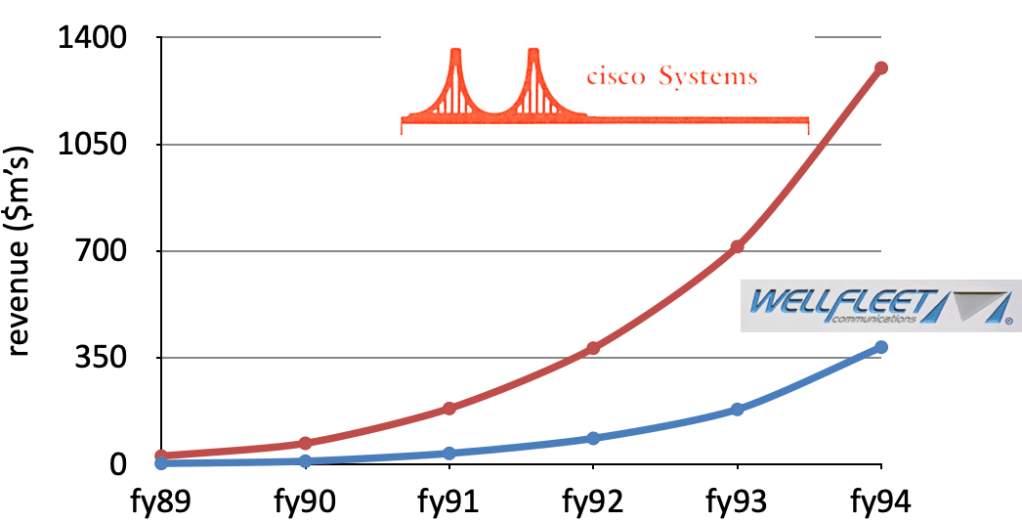

The first graph shows the revenue growth of Cisco and Wellfleet for their respective fiscal years 1989-1994. The second breaks down the total market by share for Cisco, Wellfleet and “others”. In the two years shown (1991 and 1993), Wellfleet grew its share of the router market from 9% to 14% when the overall market was growing at a CAGR (Compound Annual Growth Rate) of 30%. Phenomenal growth for any industry!
A closer look at Wellfleet’s revenue growth appears in the following graphic:
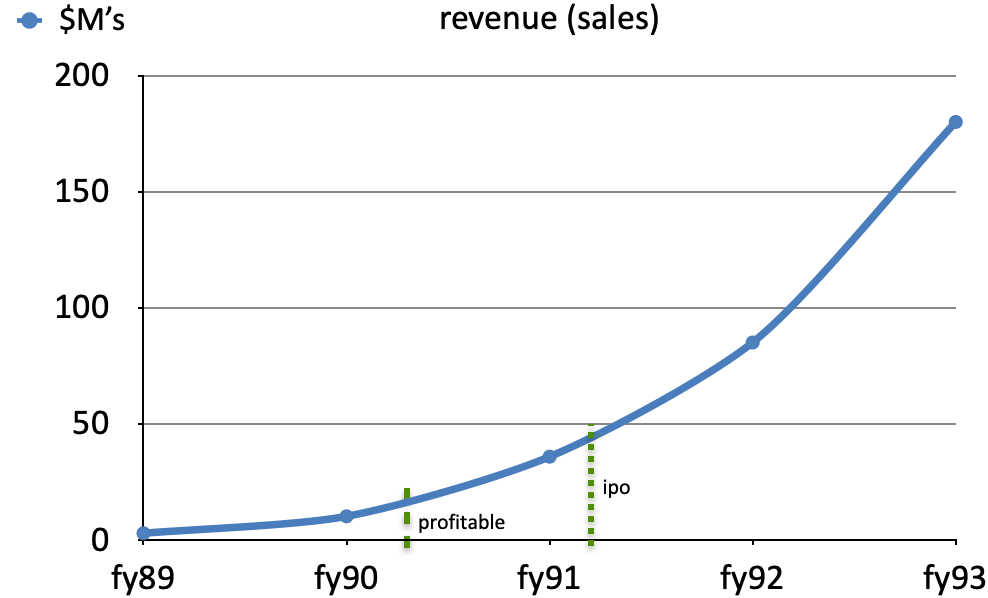
We achieved profitability in the summer of 1990 and started discussing our plans for an Initial Public Offering in the following year. Thanks to Gary Bowen’s sales leadership and outstanding execution by the field organization, we were building a backlog that was growing every month. We were convinced that the timing to go public was right, so we began to staff up the company to become a public entity.
It also meant that we were keeping the product development machine humming. The engineers began work on a “mid-life” kicker program called “Harpoon”. It was principally a performance-centric hardware project intended to go after our “big white whale” nemesis, Cisco.
In addition, through the efforts of a long list of contributors, we managed to ink a deal with Hewlett-Packard. That agreement enabled H-P to resell our LN and CN routers under the H-P name, and provided a software license for a version of our source code to be used to develop H-P’s own low-end router product. There was, however, one very large caveat – our hardware had to be engineered and manufactured to H-P’s own internal product quality standards.
That meant that the hardware engineers had to look at every board design, every IC, every mechanical assembly to be able to meet H-P’s testing and design verification procedures. It also meant that Phil Rackley’s group had to meet H-P’s rigorous manufacturing verification tests, documentation standards, and reliability criteria. It was an enormous undertaking, but if it meant that our products were to be sold under the H-P brand, we were thrilled to tackle it.
In June of 1991, we held a five-year anniversary celebration. In keeping with the personality of the company’s CEO, it was a low-key affair – an outdoor barbecue with burgers and dogs, logo-ed plastic beer cups, celebrants mostly limited to employees only. There was a restrained atmosphere. We had traveled a long way in five short (long?) years. It had been arduous, difficult, contentious, and rewarding. A time both for reflection on what we had accomplished and anticipation for what was before us.
For me personally, it was a time of foreboding. Dark clouds occupied my thoughts on that bright, sunny day. I couldn’t put my finger on it, but I knew that something was brewing that would limit my future days as a Wellfleetian.


 behind the towers
Leave a comment