
Every startup technology company has a set of customers willing to assume the risks of purchasing products from them. Geoffrey Moore terms them “early adopters” because they aspire to be among the first to explore the costs and benefits of new technologies. In Wellfleet’s case, we were offering a new product category, one that the industry had not seen before.
True, bridging and routing were not new technologies on their own, but no one had combined them in the way that we had. Furthermore, we also believed that our ace-in-the-hole was the product’s system architecture. We had, at least to my mind, successfully created a truly scalable hardware and software architecture, applied it to a very thorny problem, and were going to deliver it to a product market that was poised for exponential growth. Or, so we thought.
Introducing a new product category, near the very beginning of a developing market, from an unproven manufacturer is fraught with risk. We were asking a lot of our prospective customers. It was mandatory that we deliver on several fronts at once – functionality, feature sets, quality, reliability and service. Most of these qualities were embodied in the product, but service and support are delivered by people. As always, we were thinly staffed on every front.
One proven method for mitigating risk, and leveraging an existing service and support organization, is to seek out reseller relationships with established vendors within the “ecosystem”. In the US, Network Systems Corporation (NSC) of Brooklyn Park, MN, was a reasonably well-known and respected supplier of proprietary high-speed network hardware called HYPERchannel. Operating at 50Mbps, it was designed to connect IBM and CDC mainframe computers to peripheral devices within a building or campus. Problem was, Ethernet was proving itself adept at meeting the same requirement at much lower cost and nearly equivalent performance levels owing to its simplicity and lower protocol overhead. It was becoming a real threat to HYPERchannel in many customer applications.
Mark and Dick started discussions with Network Systems (NSC) in mid-1988 prior to the release of our initial product. Network Systems needed a product like ours right away to keep Cisco out of their accounts. In the spirit of “the enemy of my enemy is my friend”, NSC approached us about reselling our LN product, re-badged as an NSC product. Sometimes, it’s better to be lucky than smart.
NSC did not produce a lot of revenue for Wellfleet. It was clear after only a few months that their sales force was more interested in selling more HYPERchannel equipment than Wellfleet routers. Our products were priced well below that of the HYPERchannel hardware, so the NSC sales reps didn’t make as much commission selling our products. Nonetheless, theirs was a quality organization with access to a number of prestigious customers, which enhanced our credibility and reputation.
We developed a similar relationship with Newbridge Networks in Ottawa, Ontario. They had a similar product need, but at the other end of the price/performance spectrum owing to their focus on the use of voice-grade circuits for carrying point-to-point data over T-1/E-1 multiplexed trunks. Our T-1 multiplexer board performed an analogous function using the DS0 channels for carrying HDLC-framed DECnet, IP, etc or bridged traffic.
Our products made forwarding decisions based on data link or network layer information, which meant that we could deliver traffic onto any type of network. Newbridge’s channel banks were constrained to one or more DS0 channels connected to another Newbridge channel bank. Newbridge’s customers required more connectivity options, particularly where one or more Ethernets were available. So, Newbridge approached us about developing a reseller relationship similar to the one with NSC. Again, Mark was at the epicenter of these discussions, and was instrumental in signing Newbridge as a reseller. Again, Newbridge did not contribute much to Wellfleet’s top line.
Our other channel partners in the US were not very productive either. Occasionally, one of them would introduce us to a prospect that turned into a direct customer, leaving most of the real selling effort to us, to Paul Sylvia in particular.
One such customer was Mike Sobieski at 3M, St Paul, MN. He was the head of data networking for 3M’s headquarters, a very large campus of several large buildings that encompassed every facet of 3M’s operation – administration, manufacturing, chemistry, engineering, etc.
I happened to be traveling with Dick Kendrick making sales calls with one of our Midwest rep firms when we called on Mike Sobieski. He had a long list of requirements that we could not meet at that time, but he also seemed willing to work with us to give us the opportunity to deliver what he needed when he needed it. This approach became the template for several opportunities that presented themselves later on in the life of Wellfleet.
Sobieski and 3M became one of Wellfleet’s best and most loyal customers. I think Mike appreciated our direct and honest approach in our dealings. I am particularly proud of my small role in helping to make that happen. It was always interesting to see the reaction of an audience for our product presentation when we would put up a slide titled “Our Customers”, listing 3M at the top.
Other early adopters customers included:
Bear Stearns, New York, NY
Combustion Engineering, Stamford, CT
GTE Government Systems, Waltham, MA
Raytheon Submarine Signal Division, Portsmouth, RI
These companies became Wellfleet customers because of the tireless efforts of our direct sales team led by Paul Sylvia. Our installation and support team, led by Benson Rosen, were John Bullock, Steve Mastrorilli, and Don Morrill.
Steve Mastrorilli writes:
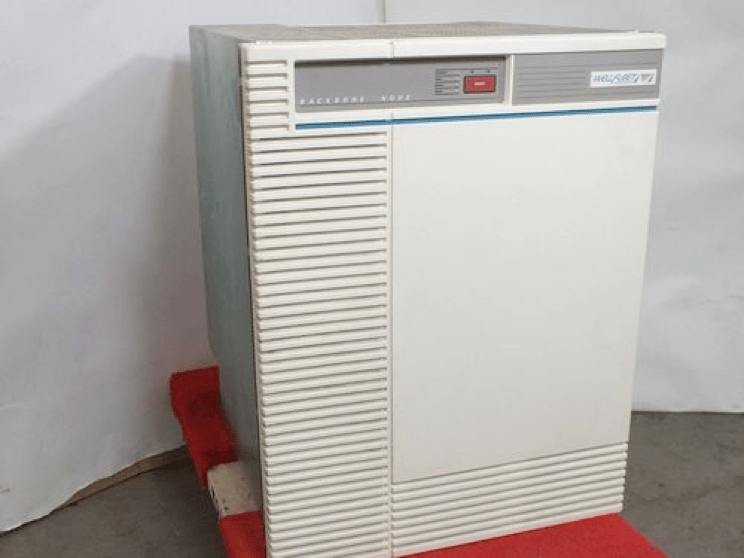
I think this may have been the first production CN installation. Bullock, Doyle, and Morrill may be able to add/delete/clarify all this…
Rusty Rowell, one of our biggest supporters, of Combustion Engineering in Stamford, CT purchased a CN. Way to go Paul Sylvia (RIP)!! So, given our revenue targets at the time, it was rather important that we get this installed and be able to report back to the OC and investors that Rusty was “up, running and happy” with his new CN.
Unfortunately, getting one of only TWO production-ready CNs to stay up in the lab for more than a few hours was proving difficult. OK, impossible!
Don Morrill had spent the weekend in Bedford attempting to burn in the boxes. But they just kept on crashing (new hardware, new software…). So, the decision was made, I’m not sure by whom, that if one of the boxes could stay up for more than a few hours then that was the box we would take to CT. What could possibly go wrong?
On that Sunday afternoon Bullock and I walked into the “manufacturing area” in 12 DeAngelo to find the two CNs side by side. One had a Post It note on it from Morrill. It said “take this one.” Apparently, that one crashed LESS than the other one!
So Bullock and I load the entire future of the company into the back of a rented minivan. Then, along with Doyle, we climb in and personally chaufer the CN to Stamford. We then park the minivan, with its precious cargo, overnight in the Stamford Marriott parking lot and proceed to dinner and drinks. Yes, that is correct. Three twenty-somethings skillfully balancing the future of an entire company with our age-appropriate desire to “have a few.”
Monday morning comes and I mean morning! I believe it was around 5:00am. I’m not clear on how we got the CN into the building, but I know it wasn’t easy.
In any case, Rusty was like a kid in a candy store!! His excitement would have been contagious if not for my reality that, ultimately, he may be sorely disappointed.
Install done. Traffic moving. Crash… Bullock, Doyle, and I are doing all we can with our very limited debug capabilities, to no avail.
Again, I would need more detail from Bullock and Doyle but I believe we ended up bridging DECnet and things were actually stable when we left to fly to Buffalo to upgrade SUNY Buffalo for Steve Wren. Story for another day…
One of my biggest takeaways from this experience was Rusty’s excitement. I had been on many installs, upgrades, etc prior to Wellfleet, but I had never seen the childlike emotion that Rusty had for the technology. That’s when I started to realize I might be into something special.
It was becoming increasingly clear that our US distribution strategy of employing regional distributors and manufacturers’ reps was not working. Our products were too complex and the selling process too protracted for a distributor sales force with dozens of products and suppliers on their line card to successfully close business for us. We needed to build a dedicated direct sales and support organization. And that Dick was not the person to build it.

 behind the towers
Leave a comment