
Mark Strangio was hired by Dick Kendrick in the spring, 1987. His initial assignment was to create Wellfleet’s first marketing collateral – a company brochure, product brochures and data sheets for the company’s initial products, the Link Node (LN) and Concentrator Node (CN). Mark was an accomplished marketing executive with Codex (the first of the FCGs) and a known quantity to Dick. Mark was a prolific creator of material which served the company for many years.
A topic of some debate centered on the creation of a technology seminar – a seminar series maybe – that would educate prospective Wellfleet customers on the technologies that we employed in the products, where they fit in a customer’s network, leading to the inevitable “informercial” for our products. We had successfully employed this technique at InterLAN some years before, and many of us were convinced that the same idea would work for Wellfleet.
The market was fragmented and confused at the time. Before Ethernet came along, computer networks were the domain of computer manufacturers – proprietary, closed architectures that were designed to restrict customers to a one-vendor solution for their distributed computing requirements. The rapid adoption of Ethernet as an open-systems solution for local area networking gradually undermined single-source, vendor-proprietary systems. The possibility of building multi-vendor networks around a set of open systems standards now seemed feasible. Wellfleet was going to help disrupt the computer networking closed-system status quo.
The first step in achieving open systems networking – the ability for any computer system to “talk” to any other computer system, regardless of manufacturer – was to connect each computer to the same networking infrastructure within a “local area”, however that was defined. Ethernet proved to be a superior solution for a very wide set of applications, physical layouts, and number of computer systems within a building, between a few buildings, even over a modest sized campus.
Once a given installation reached the constraints of a single Ethernet, the issue became how to best connect multiple Ethernets together. The problem was exacerbated by the proliferation of the vendor-proprietary architectures. Obviously, Wellfleet had its view of how best to accomplish the connection of multiple Ethernets within an enterprise. We needed a way to communicate that point of view to prospective customers in a persuasive fashion.
The concept of technical seminars was an outgrowth of an old idea – mold the sales message to that of an engineer-to-engineer conversation with a slide deck to illustrate the main points. Technology decisions are the domain of technologists, so we needed tools to deliver our message. Mark’s task was to create those tools, quickly.
Mark was a FCG. He had limited experience in marketing Ethernet products. He was exposed to the Ethernet standard prior to joining Wellfleet during his brief tenure with Banyan Systems. He did, however, have the ability to rapidly ascend steep learning curves, and Wellfleet provided him several learning curves to master at once – Ethernet fundamentals, higher-level protocols, the ISO model, functions of bridges, routers and gateways, the internal operation of the Wellfleet architecture, etc. Lots of stuff to learn. And not much time.
Mark devoted countless hours to learning, creating, listening, writing, listening some more. He became an “A” student in the translation of engineering-speak networking jargon into plain English. We wanted every Wellfleetian who came into contact with a prospective customer to be articulate in describing our products, our mission, and our vision. The collateral that Mark produced needed to provide the foundation for internal training as well as customer education on what we did and, to a degree, how we did it.
The result was a set of collateral material that proved its value over the course of the next several years, hundreds of seminars, and thousands of attendee prospects. The seminars themselves ceased being a function of the Wellfleet corporate sales and marketing organization, and was disseminated throughout the field organization. As Gene Wahlburg, our Director, Southwest Regional Sales put it, “Wellfleet is a slide-rich company”. Later, Steve and Gwen Larsen set up a self-service facility that allowed any Wellfleet field employee to download presentations on every topic that was related to internetworking.
Examples of the earliest material are shown below:
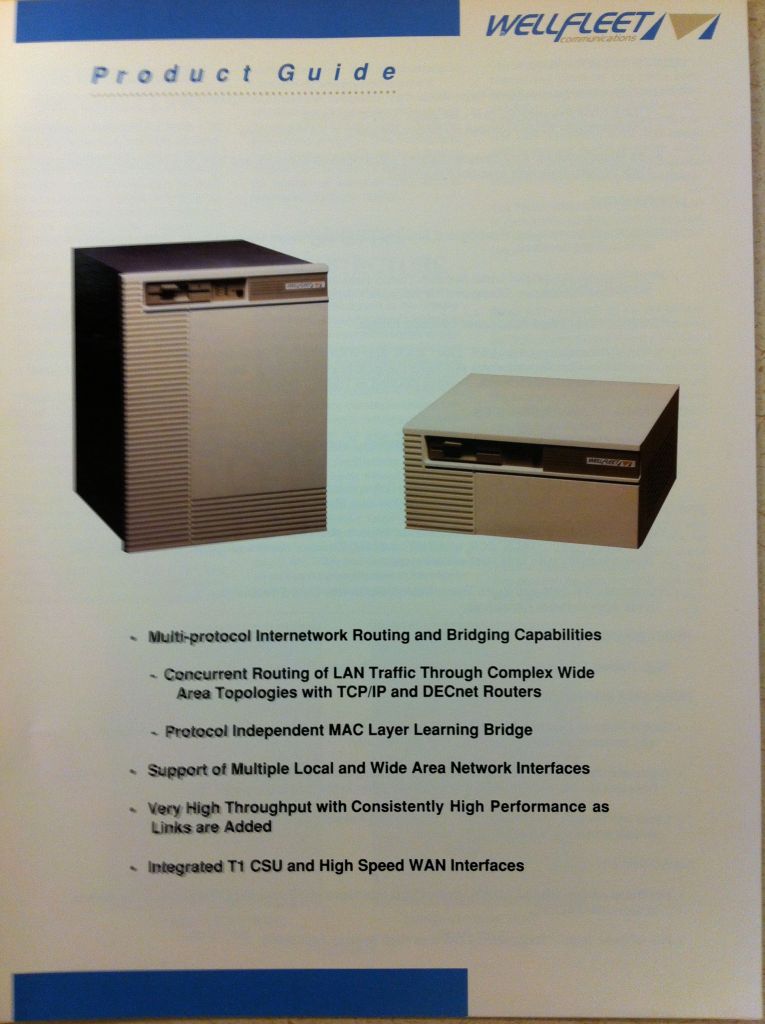
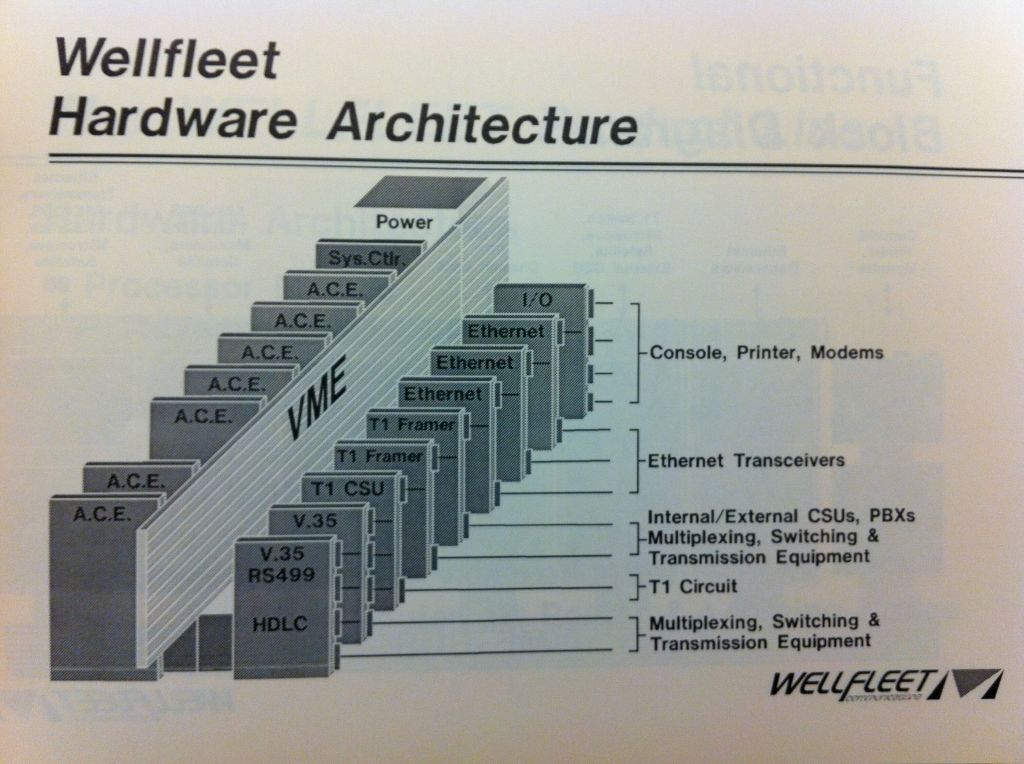
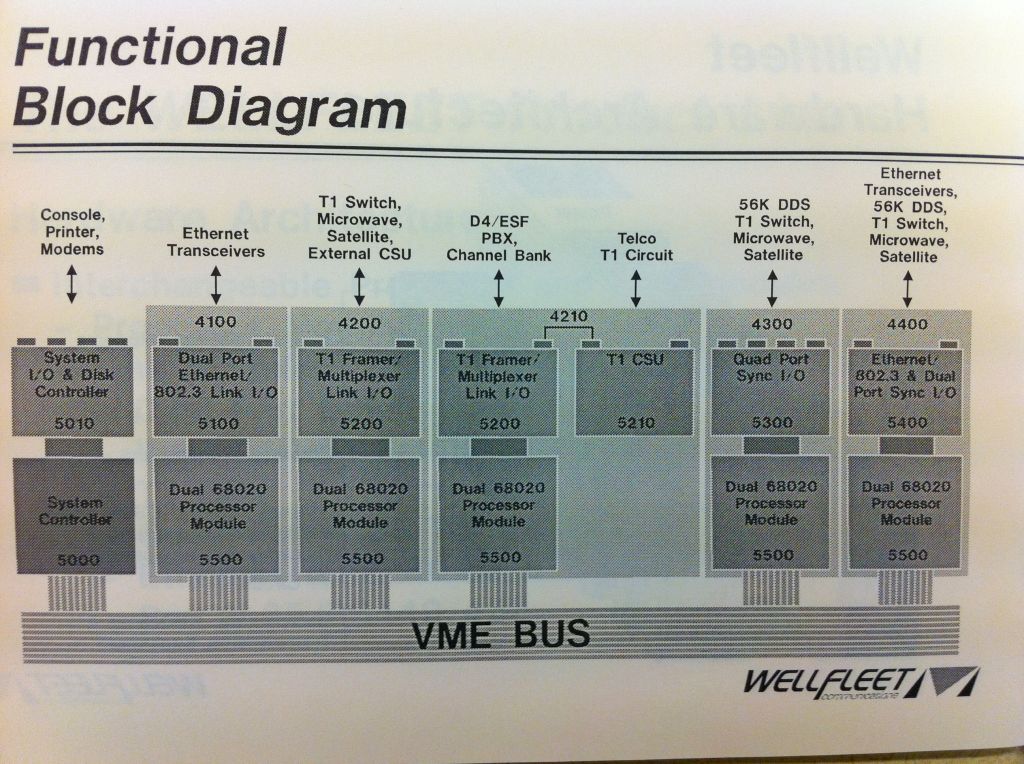
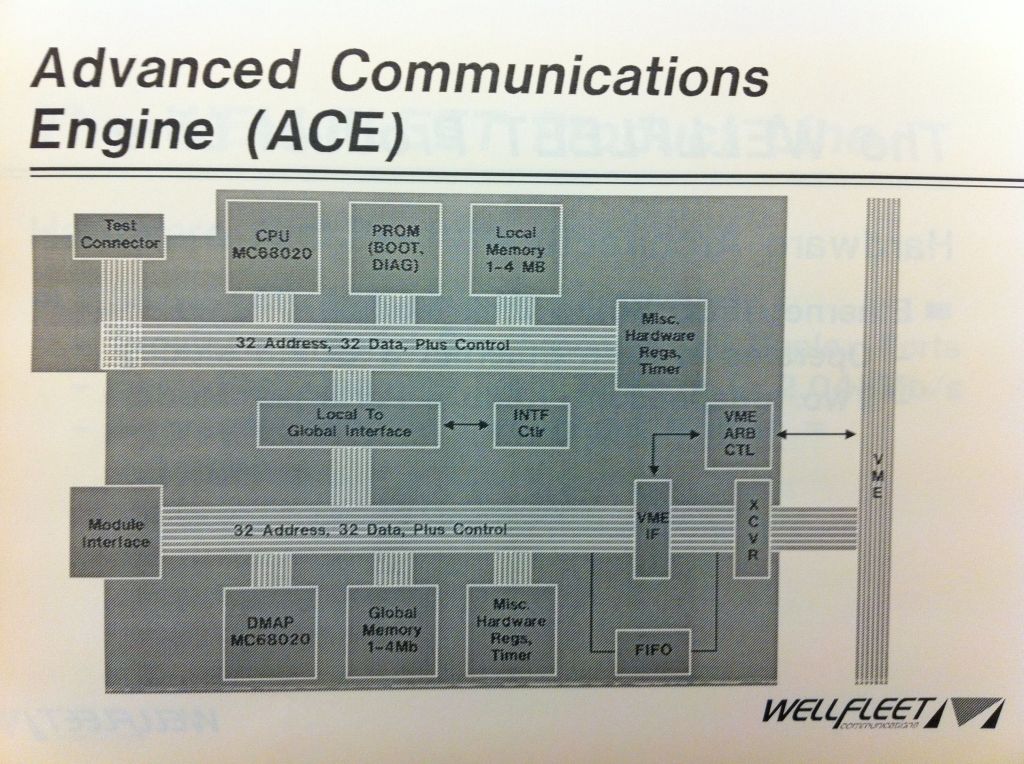
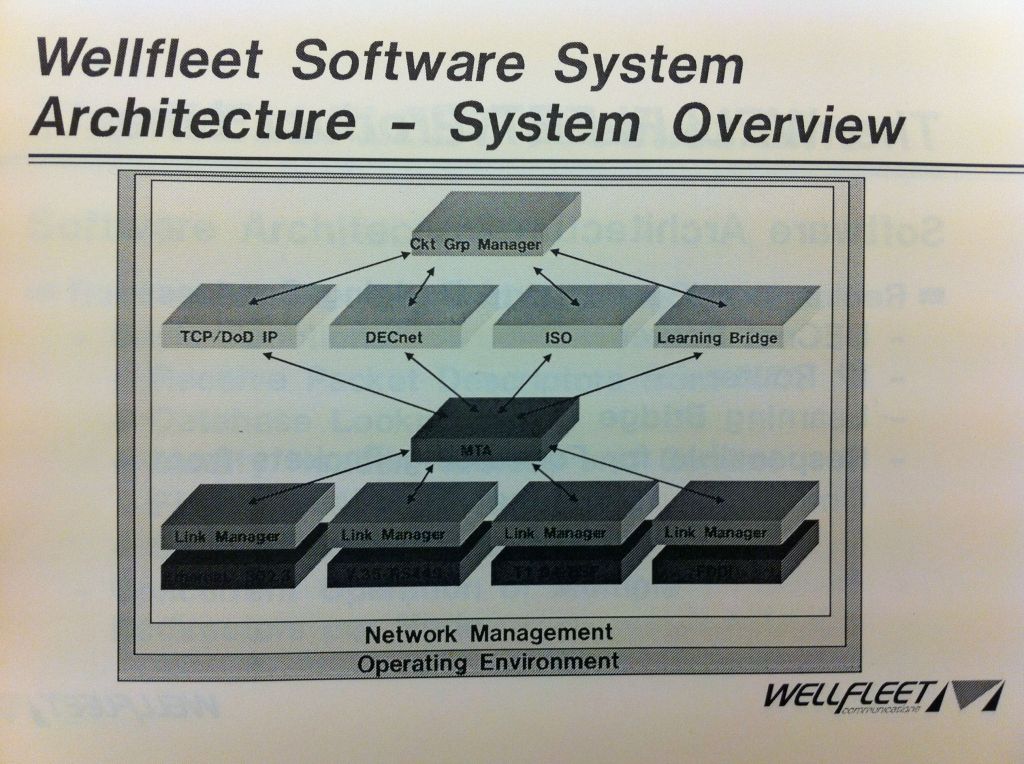
The purpose of marketing is to generate sales leads, information useful to the sales force to identify, qualify and acquire a customer. Mark’s efforts were readily embraced by our nascent sales team, particularly by Paul Sylvia. Mark’s material Paul’s relentless energy landed Wellfleet’s first customer in Raytheon’s Submarine Division in Portsmouth, RI during the summer of 1988.
I accompanied Mark and Benson Rosen in installing the first Wellfleet Link Node (LN) in a customer network at Raytheon’s facility. It was setup initially as a learning bridge for all of their traffic, with the intention of eventually routing the DECnet traffic within one building. It was an ideal first customer environment – physically close to our offices, low traffic volume, simple network topology. We struggled with software stability – the product was just not ready yet. Nonetheless, the customer was extremely patient with us, and Paul was a master of persuasion.
There was still a lot more work to do, and first revenue remained elusive.

 behind the towers
Leave a comment