
We found the building where we decided to initiate Wellfleet operations in June, 1986. It was a 9,600 sq ft office building on one floor in a small industrial park in Bedford, Massachusetts. The address was 12 De Angelo Drive, then occupied by an MIT human resources group affiliated with Lincoln Labs which was based at nearby Hanscom Field. The front half of the building was fitted out with a handful of closed-in offices around the perimeter, while office cubicles occupied the rest of the open area. The back half was essentially empty, which we planned to use as a combined lab and final-assembly-and-test manufacturing area. It seemed well suited to our needs.
Collectively, the founders had considerable experience in manufacturing board-level products at Interlan, but not to the level of sophistication that a complex system-level product was going to require. I was convinced that we should subcontract all of the board-level manufacturing operation – pcb fabrication, components kitting and stuffing, wave soldering, and basic functional testing – as well as the fabrication of the chassis, bezel, mid-plane, i/o connectors and power supply integration. The contract manufacturers would deliver to us batches of fully assembled, functionally tested boards and chassis ready for system integration, and assembled to customers’ orders.
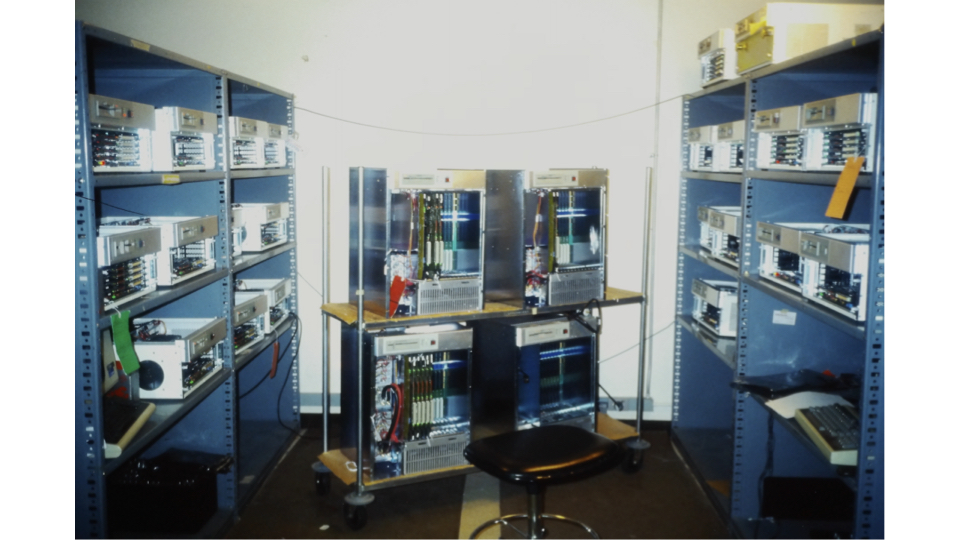
At our facility, we would insert these boards into dedicated chassis configurations to “burn-in” every one at elevated temperatures – typically around 50 C – for 100 hours. The purpose of this “burn-in” period was to accelerate any “infant mortality” of electronic components within our facility, not in our customers’ networks. This was considered a “best practice” at the time, with the objective of delivering highly reliable products to our customers.
For the burn-in operation, we constructed a dedicated, fully insulated room inside the unoccupied, back half of the building. Once we placed enough mobile racks loaded with test chassis into this burn-in room, the heat generated by multiple fully-loaded systems proved sufficient to drive the room temperature above 50 C. Needless to say, humans did not choose to stay in the burn-in room for very long. There were times that our customer support engineers did endure the heat for hours to solve a myriad of customer problems.
Phil Rackley was hired in the spring of 1987 as Wellfleet’s first Vice President, Manufacturing. Phil had had a long and storied career within the computer and communications industry inside the 128/495 corridor. Prior to joining Wellfleet, Phil was the vice president of manufacturing for Davox, a company that integrated voice and data for large enterprises. He was a polished, business-minded manufacturing professional with a lot of experience in managing multiple suppliers and contract manufacturers, and he instinctively knew how to grow his team as customer demand increased.
When I interviewed Phil, he asked me a lot of questions about the market for what were building, but he was particularly skeptical about our idea for voice/data integration over T-carrier circuits. Our view was that Wellfleet routers were not “integrating” customer voice and data traffic; we simply wanted the internetwork data to share the T-1 bandwidth with channelized voice.
There were clear economic advantages to our approach. Ultimately, we found that this did not appeal to our customers. We found that in large enterprises for which the economics were most compelling, there were organizational barriers between the “data guys” and the “voice folk”. Furthermore, senior management had no interest in putting the two operations together because they perceived excessive risk in doing so. Data operations were considered “unreliable” while stable voice service was “mission critical”. No one wanted to jeopardize their voice network for potential savings reliant on unreliable data services.
Phil’s skepticism was well-founded as it turned out. However, I believe that I convinced him that irrespective of our ideas about voice and data sharing expensive bandwidth there was a large and growing market for LAN interconnections without sharing wide-area bandwidth with voice traffic — internetworking.
Paul Volk and I had brought on a few vendors that we needed to deliver prototype boards, chassis, etc. for product development and system testing. As the manufacturing operation began to ramp up, Phil took over the management of those vendors and added others. We sought out contract manufacturers that could supply both low-volume prototypes and higher volumes at lower unit costs when we were ready. Phil delivered on this objective, and proved to be an effective negotiator for price, delivery, and quality – no small feat.
First revenue shipments were delayed by multiple quality problems affecting practically every part of the system’s design. Particularly worrisome was the low priority given to customer-facing software features and functions. I shoulder the responsibility for the lack of attention in these areas. One of the primary duties of a vice president of engineering is to ensure that adequate resources are brought to bear upon all of the tasks at hand. I had not paid enough attention to our product’s control, configuration, and management functions.
I didn’t properly staff that area, so many of the software engineers were drafted to plug the holes in addition to continue to deliver on their assigned tasks. Steve did yeoman service in implementing much of this work himself, putting in countless hours during nights and weekends. Despite the efforts from him and others, it became apparent that we were racing toward a deadline that wasn’t achievable.
Jeff McCarthy came to Wellfleet from Masscomp in the fall of 1988, taking on the task of materials management. He had the unenviable task of negotiating with numerous sales reps for all of the components that we had designed in, especially some parts that were new to the market from immature chip manufacturers. He had to manage the inventory, kit the parts for the contract manufacturers, and manage delivery timing in order to meet a committed customer delivery date. Jeff proved invaluable at ramping up production at precisely the right time.
We also needed manufacturing engineering talent to create and document the entire manufacturing process, including material flow, assembly, system testing, and quality control. Lloyd Carney, who came to Wellfleet from Proteon, a nascent competitor in routing, provided that talent. Lloyd was a bright, hard-working, engineer who delivered all of that. He would later demonstrate that his talent extended far beyond the manufacturing floor. Years later, Lloyd would continue to enhance his entrepreneurial skills by becoming a highly successful serial CEO for multiple startup and started-up companies.
Jeff and Lloyd brought an upbeat, enthusiastic attitude to their respective jobs that infected the entire company. They sparked an avalanche of additional hires (including more FCG’s) who served to raise Wellfleet’s energy level ever higher, spreading throughout the company, most particularly within sales, customer support, and service ranks.
This was to become one of the company’s greatest assets as we anticipated engaging our archenemy, Cisco, in “The Great Router Wars” throughout the 1990s. In late 1988, we were convinced that we had a superior hardware platform, and we were working hard on closing the gaps in software features. We needed more customer validation to provide the proof. By the end of 1989, we were on the verge.

 behind the towers
Leave a comment