
Steve and I spent practically all of our time in May, 1986, working on the product idea and development plan. It was a daunting task primarily because we had little insight into the product market. Conceptually, we were comfortable with what we wanted the product to do, but we had no idea what price customers would be willing to pay, what their expectations of throughput performance would be, what the control plane would look like, etc. So early on, we decided that we would simply make some simple assumptions about the product’s design and deployment in a network and test them with a handful of “friendly” prospects. We knew a number of experienced network engineers and industry analyst types from our time at InterLAN, so we put together a few slides and made a few phone calls.
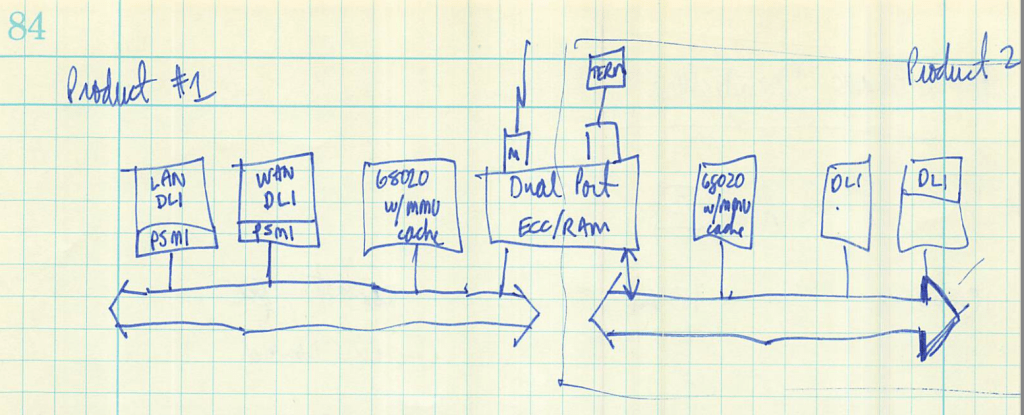
“PerCom” system architecture block diagram, May, 1986 – courtesy Steve Willis
Once we had scheduled a few “remote” presentations, we spent a few days talking to these very knowledgeable prospects and thought leaders. Doing a “remote” presentation in those days meant building a slide deck on a first-generation Macintosh computer using primitive software such as “Paint”. We printed out the deck on a dot-matrix printer, made a few paper copies for ourselves, and then faxed a copy to each of our potential customers. We then talked them through the slides over the telephone. It was primitive by comparison to modern day Zoom presentations, but it was actually quite effective. The fax copy gave our audience time to review the slide deck in advance of our phone call, allowed them to make note of any comments or questions for the call, and served as the first crude marketing collateral.
By no means was this a valid market survey because we only spoke with a few smart people, but we did learn a few things that later turned into specific design objectives. For one, we heard that a forwarding rate of 1,000 packets per second would be a reasonable goal for the initial product release. A price of $1,000 per port for each network interface was acceptable to several.
Remember, this was in May, 1986. Though these data points managed to become ingrained in the minds of our management, future events would quickly invalidate them over the course of the next 2-3 years that we spent in product development. Such is the nature of fast-moving technology markets. Plus, there was a competitor lurking that we did not even know existed – Cisco, then known as “cisco Systems” – that had a two-year head start, having shipped their first routers in late 1984.
In fact, Cisco had ordered a number of NI3210 Multibus Ethernet Controllers from InterLAN that I became aware of in the spring of 1985 when I was appointed Director, Marketing and Development by InterLAN’s new owner, Micom Systems. I had P&L responsibility for InterLAN’s original Ethernet controller board business, so I routinely reviewed all large orders that came in from our sales operation. In May, 1986, however, I had not recognized the significance of Cisco’s purchases from Micom-InterLAN. We were about to go to battle with an enemy that we didn’t know existed.
Wellfleet missed an early warning signal of the impending Great Router War of the 1990’s.

 behind the towers
Leave a comment