
The summer of 1986 was the time that recruiting the engineering team became urgent. Steve Willis and I realized in late May that we had neglected to even begin the process of finding the core group of engineers that we needed – hardware designers, communications protocol experts, software developers, and technician talent. I was keenly aware that we also had to identify suppliers who would deliver elements of the product development that we chose to outsource – product packaging design and mechanical engineering, printed circuit board layout designers and fabricators, chassis makers, power supply manufacturers, and contract manufacturing facilities to produce the prototype and early production units. We also needed to create the product development environment – computer systems, software development tools, lab facilities, test equipment, parts stores, benches, desks, office cubicles, etc. We needed everything – particularly experienced engineers – right now!
Sometimes, you get lucky. One day we were paid a visit by a young recruiter who had just moved into the Boston area from Dallas. His name was Ed Takacs. He was calling on promising young companies and startups in the greater 128/495 area and had found us at our new offices at 12 DeAngelo Drive in Bedford, Mass. Ed was a lively character, obviously ambitious and anxious to find his initial recruiting assignment in the Boston high tech arena. Steve and I listened to his sales pitch, asked him about his pricing, and told him that we would get back to him “soon”.
After a brief conversation with Dave Rowe, Steve and I concocted a “package price” for the first hires that we made through Ed – $5,000 for the starting five engineers. We never thought Ed would go for it, but after a brief discussion about the profiles of engineers that we were looking for, he agreed! Steve and I were stunned. We were experienced at dealing with engineering recruiters at InterLAN, and knew that our proposal was well below market prices. Nonetheless, we also knew that Ed was new to the area, he was clearly hungry for assignments, and we thought that maybe he would view us as a credible reference for the future.
Ed delivered. The first five hires that we made through Ed were: Paul Volk, Steve Collins, Terry Bradley, Dave Morris, and Charlie H (I have omitted Charlie’s full name because he didn’t last long). We paid Ed his $5,000 for the initial hires, upped his fee for each subsequent engineer that we would hire, and told him to keep going.
Formulating an interview process was something that Steve and I gave a lot of thought to. We decided early on that we did not want to hire more InterLAN engineers even though we had hired a lot of really good people at InterLAN. We wanted to create a different culture, one unique to Wellfleet, but we also knew that it was important that the core engineering group have experience in working in small companies if not in one or more startup environments. The set of engineers with networking experience in small companies, never mind startups, was quite small.
We interviewed a lot of candidates, many of them possessing experience only in large companies. After all, this was eastern Massachusetts where the dominant high tech companies were Digital Equipment, Data General, Prime Computer with a smattering of “started-up” companies like Apollo Computer and Masscomp. Bill Poduska, the CEO of Apollo, had been the Vice President, Engineering at Prime Computer when Paul Severino was there, so he was well-known to Paul and therefore recruiting from Apollo was off-limits. It took us months to recruit the starters.
Steve set up a desk in the middle of the 5,000 square feet of empty space that would later serve as our hardware development lab and manufacturing space. He brought interviewees into this gaping vacuum, sat each one across the desk, and proceeded to ask questions like “are you really ready to do a startup with minimal resources?” It was very effective in eliminating the tire-kickers from consideration.
One particular area of expertise that we were very anxious to acquire was in the area of using T-1s serial links for forwarding datagrams over long distances. We made an offer to “Dean” who had an excellent resume’, was a very seasoned engineer, and seemed excited to be involved in a startup. Jennifer drafted his offer letter, Paul Volk (“PV”) signed it, and we presented it to Dean in person. He said that he would start in two weeks after he had given his current employer adequate notice. Two weeks came and went, no Dean. PV and I reached out to him over telephone, he said that he would be with us in another week. Another week goes by, no Dean. Finally, we called what we thought was his previous employer to ask when he had left the company. We were told that he hadn’t, he had never resigned. After that, Dean simply disappeared – he never told us why he had changed his mind.
Eventually, Ed helped us get to the full complement of engineering talent that we initially thought that we needed. Here is the complete roster (in alphabetical order by group), with their initial design and implementation responsibilities:
Paul Volk – Director, Hardware Engineering
Rich Collins – Principal hardware engineer – designer of the ACE (Advanced Communications Engine), ethernet interface board, VMEbus system controller
Charlie H – Hardware design engineer – assigned design of VMEbus system controller, but released for poor performance
Dave Morris – Hardware design engineer – designer of T-1/HDLC serial line interface boards, integrated T-1 CSU board
Alden Smith – Hardware technician, lab supervisor, prototype hardware fabrication and testing
Steve Willis – Director, Software Engineering
Steve Ames – Senior software engineer – design and implementation of VLSI device drivers, diagnostics
Jan Bialkowski – Software engineer – run-time system environment, utility infielder
Terry Bradley – Senior software engineer – design and implementation of VLSI device drivers, diagnostics, real-time performance test and measurement
Steve Collins – Senior software systems engineer – design and implementation of interprocessor communications module, DMA processor software; systems architect
Bob Doyle – Senior software engineer – DECnet routing software design and implementation
Robin Littlefield – Software engineer – learning bridge software design and implementation
Asher Waldfogel – Principal software engineer – software system architect, design and implementation of IP routing software
I have to single-out Alden Smith, our hardware technician, for his yeoman effort during this period. Alden was the single most energetic tech that I have ever worked with, before or after Wellfeet. He was the most responsive, conscientious, hard-working, dedicated individual in the company.
Alden was very bright and ambitious, possessing a highly refined “antenna” for receiving important nonverbal signals from management. Shortly after we had settled on the initial packaging concepts for the first generation products – the “Link Node (LN)” and “Concentrator Node (CN)” for the five slot and fourteen slot chassis respectively – Sev and Alden began working in earnest on fabricating the prototypes for the CN. Of course, working directly with the CEO on a project meant that Alden was not visibly supporting the rest of the engineering effort. But despite the lack of visibility, Alden managed to complete every task thrown at him in short order, with top-notch quality.
By the fall, we had assembled enough of the core development group that we felt confident that we could begin working on the product architecture and high-level design. Throughout the summer, we had a lot of discussions amongst a diverse group of experienced entrepreneurs about how we should think about the first product – Gardner Hendrie of Stratus Computer fame, Mike Greata and Dave Nelson from Apollo Computer, Art Carr from Codex (who became a member of Wellfleet’s board of directors), among others. We became enamored with designing the first product with a clean sheet of paper, meaning all of the electronics, packaging, software, etc would be custom designs. We went even further in specifying features that we never envisioned in writing the business plan – “hot swap” of live hardware modules, non-stop operation, dual software images for seamless upgrades, remoter diagnostics and network management.
Some of us would later regret that we had ever discussed these ideas.
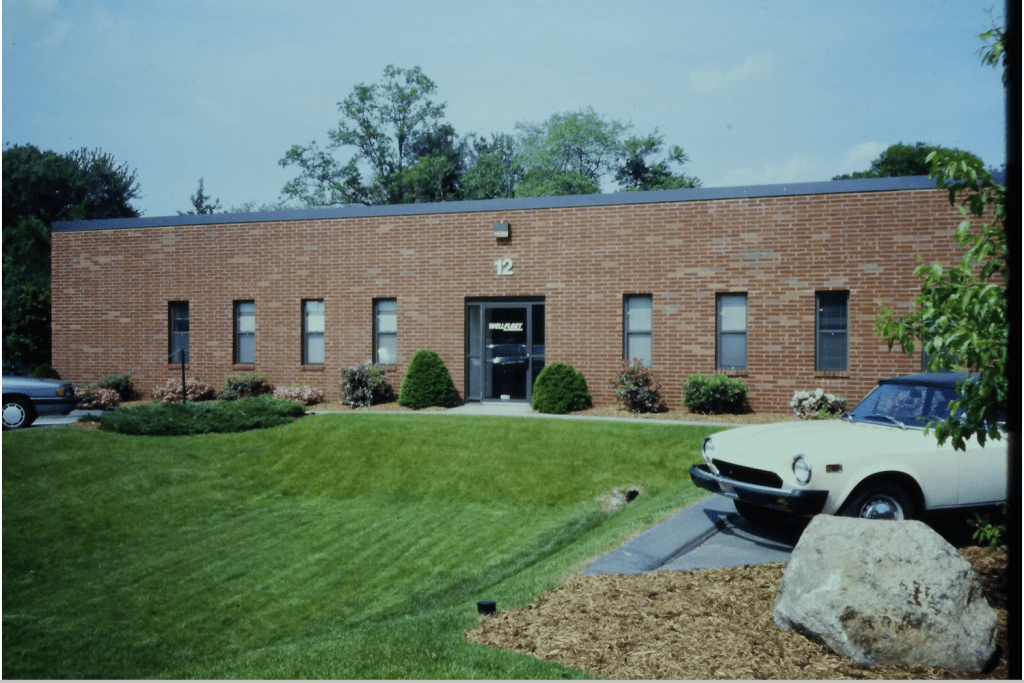


Photos courtesy of Steve Collins

 behind the towers
Leave a comment